Written By: Jharkhand State Open University Editorial Team
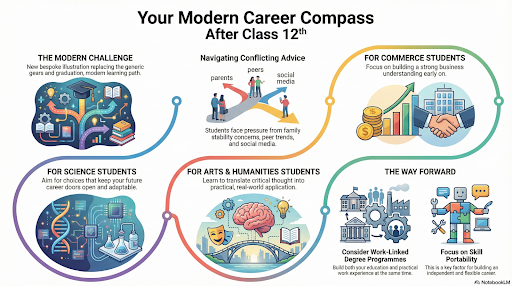
For many Indian students, Class 12 does not end with certainty — it ends with questions. Parents ask about
stability, peers talk about trends, and social media flashes success stories that feel distant and
confusing. At this stage, the real challenge is not choosing a degree, but understanding what kind of
learning path builds momentum early and stays relevant five years later.
This guide looks beyond conventional lists and explores how Indian students can think clearly about careers
after 12th, across Commerce, Science, and Humanities — with a strong focus on work-linked learning as a
practical way to build both education and experience together.
A decade ago, post-school choices were largely linear. Today, industries evolve faster than degree cycles.
Employers value skills, adaptability, and exposure — not just marksheets.
This shift explains why students searching for what to do after 12th in India are no longer satisfied with
fixed answers. The question has evolved into:
The answer increasingly lies in foundational bachelor’s degrees aligned with real-world work environments.
Students exploring options after 12th Commerce often face a narrow narrative — accounting or nothing. In reality, Commerce today feeds directly into management, operations, analytics, and entrepreneurship.
BBA works well for students asking what to do after 12th commerce because it develops:
When pursued as a work-linked degree, BBA allows students to engage with startups, SMEs, and corporate teams across Tier 1 and Tier 2 cities — gaining clarity on how businesses actually function while studying.
For students who prefer structure, numbers, and financial systems, B.Com remains a strong choice. Modern commerce roles extend beyond accounting into:
Work-linked B.Com pathways help students apply concepts in live business settings instead of waiting until graduation to step into the professional world.
Students often search for what can we do after 12th science, expecting a single “right” answer. The truth is that Science today is not only about laboratories — it is about technology, systems, and problem-solving.
Students wondering what to do after 12th science but unsure about deep engineering tracks, often find B.Sc. IT a balanced choice. It builds:
In work-linked formats, students gain early exposure to IT environments in urban and semi-urban business ecosystems.
BCA is ideal for students interested in software, applications, and digital platforms without the rigidity of traditional engineering. It suits learners exploring:
Work-linked BCA students often begin contributing to tech teams early, which answers a common concern: how to get a job after 12th without waiting years for exposure.
Get Personalised Guidance — Contact Us
Students searching for what to do after 12th arts or what to do after 12th humanities often underestimate the versatility of their skill set. Humanities builds:
When combined with structured business or technology degrees like BBA or B.Com, and supported through work-linked learning, humanities students can transition smoothly into corporate, social sector, or operations-focused roles.
Questions like after 12th science what to do for girls reflect a deeper concern — safety, sustainability,
and long-term growth.
Programs such as BBA, BCA, B.Sc. IT and B.Com offer:
Work-linked degree models further support early independence by allowing students to earn, learn, and build confidence simultaneously.
Many students ask:
While entry-level jobs exist, they often lack growth pathways. Work-linked degree programs solve this gap by allowing students to:
Instead of choosing between education and employment, students can pursue both together.
Traditional degrees delay industry exposure until the final year. Work-linked degrees reverse this
model.
Across Tier 1 and Tier 2 cities, students gain:
Degrees like BBA, B.Sc. IT, BCA, and B.Com are particularly suited for this approach because they align directly with operational, digital, and managerial roles in growing Indian industries.
For students searching what are the best career options after 12th, the answer lies less in trends and more
in trajectory.
A strong post-12th decision should:
Choosing a work-linked bachelor’s degree ensures that learning does not remain theoretical — it becomes a living, evolving career foundation.
The years immediately after Class 12 shape not just careers, but confidence, adaptability, and direction.
Whether a student comes from Commerce, Science, or Humanities, degrees that integrate learning with real
work experience create clarity early — and resilience for the future.
The right question is no longer what to do after 12th, but:
How soon can learning translate into meaningful work?
Our counselling team is ready to assist you at every step — click the button below to get started.
Need advice? Our experts are on WhatsApp 24/7—message us anytime!
Copyright © 2026 - All Rights Reserved - Jharkhand State Open University