Written By: Jharkhand State Open University Editorial Team
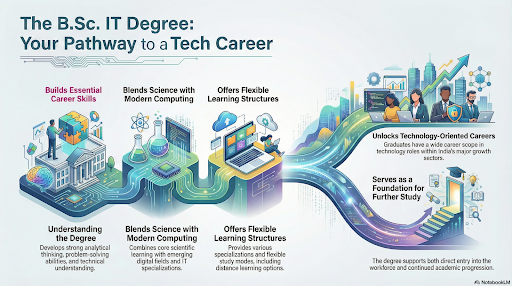
In the past few years, the Bachelor of Science (B.Sc.) degree has become increasingly relevant as science and technology continue driving India’s major growth sectors. Students choose B.Sc pathways to build strong analytical thinking, problem-solving abilities, and technical understanding early in their academic journey. Today, the degree serves as a bridge between foundational scientific learning and emerging digital fields, especially in information technology. With multiple specialisations and flexible study modes, universities now position B.Sc. as a degree that supports both academic progression and professional entry.
Understanding what is B.Sc. is important because the degree today is not limited to traditional science subjects. It is an undergraduate program that strengthens the scientific mindset through structured learning in theory, experimentation, and applied concepts. Science continues to shape industries such as healthcare, IT services, analytics, research, and environmental sciences, and this degree helps students enter these fields with clarity. As India shifts toward technology-driven sectors, B.Sc. graduates find themselves aligned with skills that industries increasingly value.
Universities highlight this degree because it builds scientific confidence and adaptability from the start.
The full form of B.Sc. is Bachelor of Science, a program recognised across academic and professional pathways. The name itself reflects a balance between theoretical understanding and practical exposure, both of which are essential in today’s rapidly evolving scientific landscape. Students choosing this degree gain structured insight into scientific models, experimental methods, and conceptual frameworks. Over time, this leads to stronger reasoning ability and discipline in approaching real-world problems.
Students often ask how many years it is, especially when choosing between science and professional programs. In India, this degree typically takes three years to complete, divided into six semesters. This structure allows learners to gradually move from foundational concepts to advanced topics depending on the chosen specialisation. The duration also supports internships, practical work, and project-based learning across different semesters.
The duration ensures students complete their scientific learning with depth and continuity.
Students explore B.Sc. course details because the degree offers a wide range of subject combinations that align with modern academic pathways. Universities design the course to develop conceptual clarity, practical skills, and the ability to apply scientific thinking to everyday challenges. This approach helps learners understand not just theories but also how these theories influence technological systems and industry processes. The course structure also supports students who wish to enter multidisciplinary careers.
These structured details make this program suitable for students who want balanced academic and applied learning.
Understanding B.Sc. subjects helps students identify which areas align with their interests and long-term goals. While the exact subjects vary across universities, they typically include a mix of core science topics and elective modules. The curriculum is designed to introduce theoretical frameworks first and gradually build toward applied components. This layered approach strengthens understanding in a systematic way.
The subject structure ensures that students gain both scientific depth and practical exposure.
Contact Us to Make a Confident Career Choice
Students often ask what do we study in B.Sc., because the degree covers a broad spectrum of concepts depending on the chosen pathway. In general, the program introduces scientific reasoning, quantitative skills, experimentation, and foundational theories that support specialised learning later. Universities use this degree to help learners understand how scientific logic applies to real systems—whether in laboratories, data environments, or industry processes. The aim is to make scientific thinking part of daily problem-solving.
This academic base prepares students for the technological and research-focused roles shaping modern industries.
The use of the B.Sc. degree has expanded significantly as industries seek graduates who can apply scientific thinking to digital environments. It is now considered one of the most versatile undergraduate qualifications because it supports both academic advancement and direct employment options. Whether students pursue IT, analytics, healthcare, or research paths, the degree provides a strong foundation. This adaptability is particularly relevant in a job market driven by data and technology.
The degree adapts easily to different career directions based on a student’s strengths.
Students considering what to do after B.Sc. often evaluate whether to pursue higher studies or enter the workforce. Both paths are valid because the degree prepares learners for academic specialisation as well as industry roles. Many graduates pursue master’s degrees, professional certifications, or specialised diplomas that deepen domain expertise. Others take up roles in IT support, operations, analysis, or research environments.
Universities guide students to choose paths that align with their interests and long-term goals.
The B.Sc. IT course focuses on information systems, programming fundamentals, networking, and digital operations. It is ideal for students who want a balance between scientific learning and technology-driven careers. The curriculum introduces system structures, application development basics, and data concepts that support modern IT roles. As organisations digitise operations, demand for graduates with IT-oriented science backgrounds continues to rise.
This program suits learners who want a structured entry into the digital and IT ecosystem.
A Bachelor of Science in IT blends scientific understanding with computing skills, making it a gateway to technical and business-support roles. Students learn how digital systems work, how data flows across networks, and how applications are developed. This combination helps them navigate technological environments with confidence. The program is especially relevant in an economy where digital operations support every industry.
This degree enhances both technical ability and long-term career mobility.
When discussing B.Sc. IT career scope, universities emphasise the wide range of roles available in both private and public sectors. Graduates find opportunities in system management, software support, data handling, and network operations. As organisations adopt digital solutions, the need for IT professionals who can support and maintain systems continues to grow. This trend ensures consistent demand across industries.
The career scope remains strong due to the ongoing digital transformation.
Career options have expanded for graduates seeking jobs after B.Sc. IT as companies adopt technology across departments. Students commonly enter roles that involve system support, network monitoring, data operations, and basic software troubleshooting. These positions help learners gain real-world exposure early in their careers. Over time, graduates can transition into more specialised technical areas.
These roles offer strong beginnings and opportunities for long-term skill development.
The rise of flexible learning has increased interest in B.Sc. IT Distance Education, especially among students who want to study and work simultaneously. This mode allows learners to access digital resources, participate in assessments online, and complete the degree without relocating. Recognised universities ensure academic standards are maintained through structured content and evaluation. It offers a viable option for students balancing responsibilities.
This model supports academic growth without disrupting personal schedules.
The B.Sc. IT ODL mode (Open and Distance Learning) provides academic flexibility backed by guided support and structured assessments. Students benefit from an organised digital platform that helps them progress semester by semester. It is suitable for learners who need mobility or time flexibility due to work or personal situations. The curriculum ensures consistency with regular programs.
This format reflects how universities are adapting education to modern learning needs. Students must have successfully completed 10+2 or an equivalent qualification from a recognised institution, demonstrating readiness for undergraduate scientific study.
Choosing B.Sc. IT is less about following a trend and more about recognising how technology shapes nearly every sector today. Students who enjoy structured learning, logical reasoning, and working with digital systems often find this program aligned with their strengths. The degree gives a clear entry point into IT environments while still leaving room for exploration, higher studies, and specialisation as industries evolve. Its relevance comes from the way it balances scientific understanding with practical digital skills—something employers increasingly expect from early talent.
For learners who want a steady, future-focused path into technology-driven careers, B.Sc. IT remains a dependable and academically strong choice that can grow with your ambitions.
Our counselling team is ready to assist you at every step — click the button below to get started.
Need advice? Our experts are on WhatsApp 24/7—message us anytime!
Copyright © 2026 - All Rights Reserved - Jharkhand State Open University