Written By: Jharkhand State Open University Editorial Team
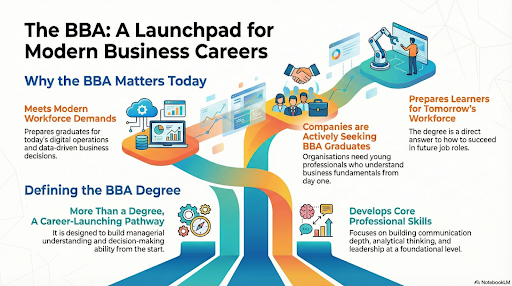
Across India’s business and service sectors, one trend is unmistakable: organisations are actively seeking
young professionals who understand business fundamentals early. The modern business ecosystem—dominated by
digital operations, data-driven decisions, and rapid market shifts—needs graduates who can think, analyse,
and lead at a foundational level.
This is where the Bachelor of Business Administration (BBA) has grown beyond a traditional undergraduate
degree. It is increasingly recognised as a career-launching pathway, designed to help students develop
managerial understanding, communication depth, and decision-making ability from the start.
Rather than asking “What is BBA?” in a purely academic sense, the better question today is:
How does a BBA prepare learners for tomorrow’s workforce, and what kind of roles does it open
up?
In today’s business environment, young learners often seek degrees that build core understanding before they take on specialised roles. This is where universities frequently address the question of what a BBA course is, because the term itself has become central to conversations around early management education. The programme provides foundational exposure to how decisions are made, how teams operate, and how organisations grow in competitive markets. Instead of jumping into narrow specialisations, students begin with a broad-based learning approach that strengthens analytical, managerial, and communication skills.
Learners study how different business functions connect to organisational goals.
The programme introduces models of human behaviour, decision-making, and strategic planning.
Industry examples and case-based learning help students understand real business challenges.
Graduates develop clarity about roles in marketing, finance, operations, and HR.
Universities highlight this broader meaning because it positions BBA as the foundation on which future
business leaders begin building their careers.
Students often want clarity on structure, timelines, and academic flow, which leads to common queries such as the BBA degree, how many years and how the programme is organised semester-wise. The standard duration is three years, divided into six semesters that gradually move from foundational subjects to applied areas of business. This format allows students to absorb concepts at a steady pace while building familiarity with real-world applications. As universities integrate digital resources, simulations, and project-based learning, students gain a deeper understanding of organisational processes.
The structured timeline ensures students complete their undergraduate learning with balanced theoretical and practical exposure.
Contact Us for Expert Academic Support
Universities often update their curriculum to match industry expectations, which is why conversations about BBA course subjects now focus on relevance and modern skill alignment. The syllabus blends traditional business foundations with emerging areas like digital tools and basic analytics. This helps students understand both the stability of established business frameworks and the dynamism of evolving sectors. The aim is to equip learners with knowledge that is academically sound and professionally useful.
The BBA syllabus reflects the shifts taking place in business and technology, enabling students to stay aligned with industry expectations.
As industries expand and diversify, universities frequently address queries like What can I do after BBA, because career pathways are no longer linear. Graduates today enter varied roles depending on their interests, strengths, and exposure during their degree years. Some move into management-support roles, others join marketing teams, and many explore financial and operational positions. Early professional exposure, internships, or work-linked learning significantly impact how quickly students grow after graduation.
Universities emphasise this flexible scope because the BBA degree adapts well to changing career landscapes.
The rise of interdisciplinary learning has created interest in programmes that combine management with other fields, leading students to ask what BBA LLB is and how it differs from traditional pathways. This integrated option blends business principles with legal education, preparing learners for roles that require both managerial understanding and legal awareness. It opens doors in corporate law, compliance, policy studies, and advisory functions. The combination is particularly relevant as organisations operate in increasingly regulated environments.
These emerging combinations show how universities are evolving to meet modern industry requirements.
With evolving learning preferences and wider digital access, BBA Distance Education has become a relevant option for students who want structured study without relocating. This mode allows learners to balance academic commitments with early work experience, internships, or personal responsibilities. Universities offering flexible formats ensure that the academic standards remain equivalent to full-time programmes, with structured assessments and guided study support. As digital learning strengthens, ODL and online BBA models have become credible pathways for students across different regions.
Flexible BBA formats reflect how universities are adapting their delivery models to meet modern student expectations.
In a business environment driven by digital tools, data, customer insights, and rapid innovation, organisations value young professionals who:
A BBA degree provides this foundation in a structured, progressive way. Whether a student wants to continue into an MBA, begin work early, or explore entrepreneurship, the BBA acts as a flexible launchpad.
Our counselling team is ready to assist you at every step — click the button below to get started.
Need advice? Our experts are on WhatsApp 24/7—message us anytime!
Copyright © 2026 - All Rights Reserved - Jharkhand State Open University